Market projections show the global AI agent sector growing from $5.1 billion in 2024 to $47 billion by 2030. Gartner predicts that about 40% of enterprise applications will include task-specific AI agents by 2026. Organizations need to review which solution best fits their specific business needs. This piece compares AI chatbots and AI agents in various business functions to help determine your organization's best approach for 2026.
What is the difference between AI chatbots and AI agents?
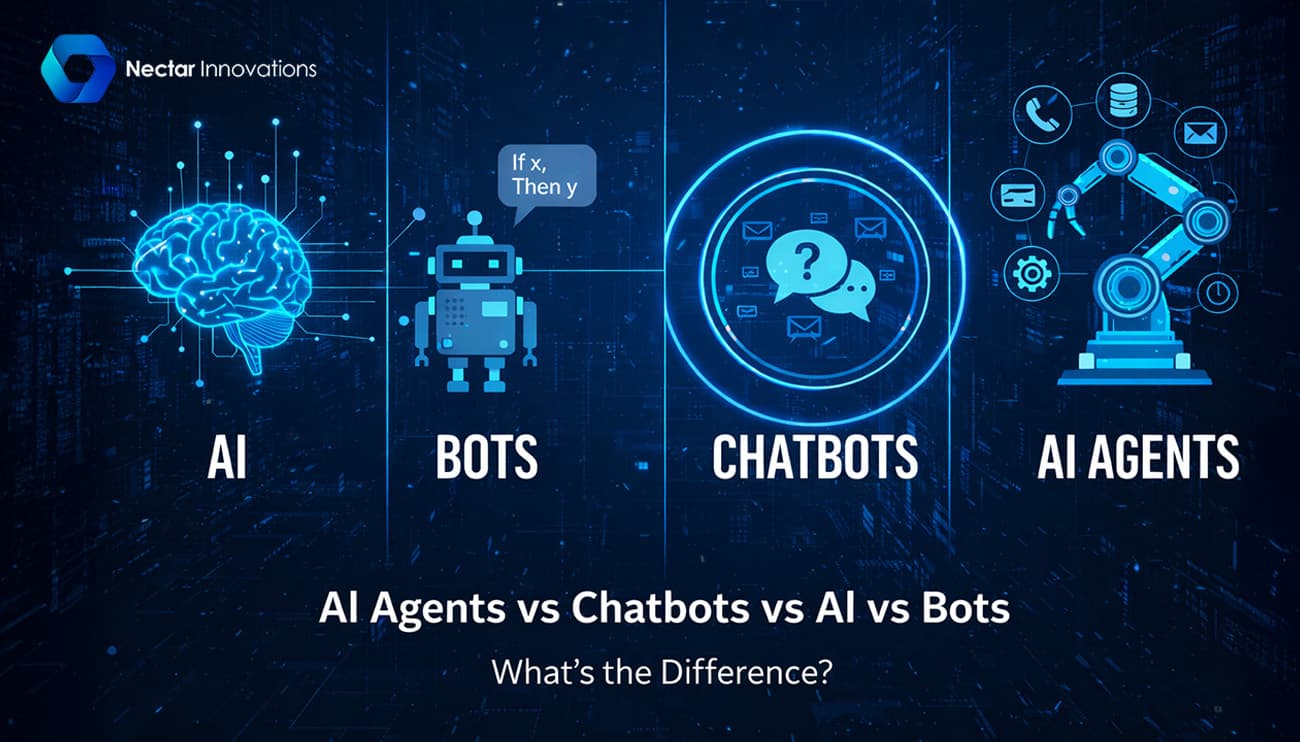
AI technologies differ in how they work and make decisions. AI chatbots respond to what users tell them through programmed interactions. AI agents can work on their own to complete complex tasks and reach specific goals.
- Definition of AI chatbots: rule-based vs generative models
AI chatbots are software applications that simulate conversations through text or voice. They come in two main types:
Rule-based chatbots work by following predefined scripts and decision trees. They spot specific keywords to trigger the right responses. These systems use simple natural language processing (NLP) to match patterns and pull up preset answers. They work well for simple, repetitive tasks. But they can't personalize beyond their programming and struggle when users ask questions in unexpected ways.
Generative AI chatbots use advanced large language models (LLMs) to grasp context and create natural responses. These systems can understand subtle meanings and adjust how they communicate. But they need users to keep providing input and focus mainly on giving information rather than doing tasks.
- Definition of AI agents: autonomy and goal-driven behavior
AI agents take capability to the next level. These autonomous systems can:
- Analyze situations on their own
- Make decisions without human input
- Complete multi-step actions across different platforms
- Learn and improve over time
An AI agent works as a self-directed program that sees its environment, gathers data, and completes tasks to meet its goals. It doesn't just answer questions - it actively works to complete objectives using whatever tools it has. These agents use sophisticated natural language understanding and decision-making algorithms. They can work with external tools and even other agents.
- Key difference: conversation vs execution
| Aspect |
AI Chatbots |
AI Agents |
| Main function |
Conversation and information retrieval |
Task execution and workflow completion |
| User involvement |
Needs ongoing interaction |
Works independently after getting direction |
| Decision authority |
Follows set paths |
Makes its own decisions |
| System integration |
Usually works in one platform |
Can work across multiple systems |
| Value delivery |
Quick answers to common questions |
Complete problem solving |
These technologies differ in how they operate. Chatbots make conversations better by understanding and responding well. Agents make systems better by taking action across applications without waiting for humans. As one industry expert puts it, "Chatbots deflect conversations; agents resolve issues."
How do AI chatbots and agents perform in real business workflows?
Real business environments reveal the performance gap between AI chatbots and agents most clearly when we explore their workflow capabilities. Gartner predicts that AI agents will autonomously resolve 80% of common customer service issues without human intervention by 2029, and this will lead to a 30% reduction in operational costs.
- Task complexity: linear vs multi-step execution
AI chatbots excel at handling predictable, linear interactions with clearly defined outcomes. They manage straightforward workflows effectively such as:
- Answering frequently asked questions about products or services
- Collecting user inputs through form-based interactions
- Providing links to relevant documentation or policies
- Routing questions to appropriate departments based on keywords
They struggle when faced with tasks that need contextual understanding or judgment. AI agents can manage complex workflows that span multiple steps and variable scenarios. To cite an instance, an IT agent receiving a "VPN connection issue" request can pull user information, check device status, initiate reset processes, and schedule technician follow-up—all autonomously.
- System integration: isolated vs cross-platform
AI chatbots' operations typically stay within specific platforms and depend on pre-built connectors for any cross-application functionality. Their limited integration capabilities often create fragmented workflows and outdated information. Teams using AI agents see 30–40% lower handling costs and can scale support without proportional headcount increases.
AI agents merge naturally with business tools like
CRM, help desks, and systems such as Salesforce, Zendesk, and Shopify. This continuous connection lets them retrieve context, update tickets, process refunds, and perform actions across multiple platforms without manual handoffs. They can compile data from different sources, analyze patterns, and execute actions throughout the entire business ecosystem.
- Learning and adaptation: static vs evolving behavior
Most AI chatbots remain static systems that need manual reprogramming or script updates to change behavior. Their growth relies entirely on human intervention, making them less adaptable to changing business needs.
AI agents, a match for traditional systems, continuously learn and improve through various mechanisms:
- Online learning helps agents adapt to new information live, staying relevant in ever-changing environments
- Memory efficiency allows processing information in small pieces instead of huge batches
- Reinforcement learning enables them to learn through trial and error
- Historical analysis lets them study previous decisions to improve future outcomes
This adaptive capability makes AI agents valuable especially in industries that need immediate response to changing conditions, such as fraud detection in finance and dynamic pricing in retail.
Where do AI chatbots and agents deliver the most value?
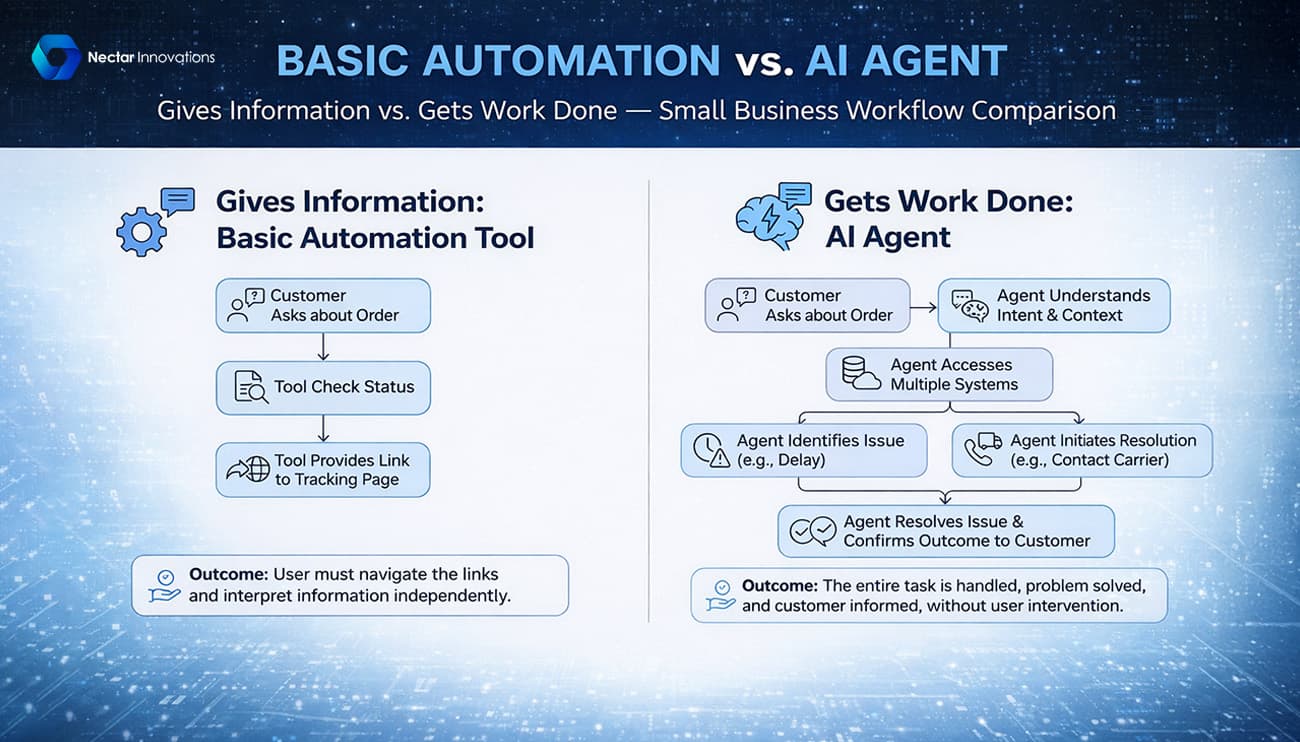
AI solutions create substantial business value, but their effects vary across business functions. The best uses depend on how complex the task is and how deeply it needs to be integrated.
- Customer service: FAQs vs full ticket resolution
AI chatbots excel at handling support questions that come up often. They cut down ticket volume by giving quick answers to common questions. Companies that use chatbots see their human agents handle 77% fewer support tickets.
AI agents, on the other hand, solve issues completely. They do much more than answer questions. These agents check account details, spot fraud, reverse charges, and let customers know when their problems are fixed. Teams that use AI agents well can solve over 90% of conversations without human help.
- Sales and marketing: lead capture vs lead qualification
Chatbots are good at capturing leads and answering simple pricing questions. But AI agents can do much more:
- They talk to incoming leads through email or chat on their own
- They qualify potential customers and set up meetings automatically
- They look at past sales data to give useful insights
Sales teams with AI agents close 10% more deals than those without them. On top of that, AI agents work 24/7 and respond faster with customized messages no matter what time zone the customer is in.
- IT and HR: basic support vs workflow automation
In IT departments, chatbots help employees with simple troubleshooting.
AI agents can diagnose problems, send tickets where they need to go, and start fixing incidents.
The difference is even clearer in HR:
| HR Function |
Chatbot Capability |
AI Agent Capability |
| Onboarding |
Schedule interviews, share policy links |
Guide new hires, track engagement, spot workforce trends |
| Employee Support |
Answer policy questions |
Cut operational costs by 40% |
| Administrative Tasks |
Simple information lookup |
Save 30 minutes on each payroll issue fixed |
- Healthcare: appointment reminders vs patient coordination
Healthcare chatbots handle scheduling and medication reminders well. Organizations use them to sort patient complaints, offer counseling, and help people understand health better.
AI agents manage complex tasks that usually slow down staff. They coordinate patient care across different locations, make discharge smoother, and speed up billing. They submit claims, fix documentation gaps, and write appeals. This lets medical staff focus on patient care while making sure everything runs smoothly for patients.
What is the ROI difference between chatbots and AI agents in 2026?
AI solutions affect finances differently based on how companies implement them. Both technologies help cut operational costs at first, but their returns change as they become more complex.
- Cost savings from chatbots in high-volume tasks
AI chatbots continue to show great returns for routine interactions in 2026. Companies that use chatbots reduce their customer service costs by 30-50%. They do this by handling common questions automatically. The numbers make sense - human support costs $15-$60 per interaction, while chatbots handle the same tasks for just $0.50-$0.70. This means a 95% cost reduction for each interaction.
Here's what happens in real life:
- Klarna's AI assistant managed 2.3 million conversations (equal to 700 full-time agents) and saved about $40 million
- Beau Ties of Vermont automated 80% of support tickets. They needed fewer team members but kept their service quality high
- Camping World's virtual assistant "Arvee" boosted customer involvement by 40% and cut wait times by 67%
- Productivity gains from agents in complex workflows
AI agents bring better returns when handling complex, multi-step processes. Teams using AI agents spend 30-40% less on handling costs. They can grow their support operations without adding more staff. PwC reports that 66% of organizations using AI agents see better productivity, and more than half save money.
These benefits go beyond just saving costs:
- AI agents reduce average handling time by 40%
- A European bank resolved cases 39% faster within three months
- Agents feel better about their work - 71% say they're more productive when AI handles repetitive tasks
- Long-term scalability and learning curve
AI agents offer better long-term returns even though they cost more upfront. Chatbots are quicker to set up and cost less at first, but they need constant updates that can eat into returns over time. Gartner predicts that by 2026, companies will use multiple digital agents to handle complex business tasks.
AI agents get better through machine learning as they process more data. This self-improvement helps companies avoid the knowledge management issues that Gartner says limit chatbot effectiveness.
The choice becomes clear for planning: use chatbots to quickly improve simple, predictable tasks. But if you want to transform your business long-term, invest in AI agents for automation and smarter decisions.
How to choose the right AI solution for your business?
Your business needs, available resources, and customer experience goals determine the choice between AI technologies. We primarily based the decision on task complexity and automation goals.
- When to use chatbots: simple, repetitive tasks
AI chatbots work best for structured, predictable processes that need clear outcomes. They excel at:
- Answering frequently asked questions about products or services
- Capturing simple lead information
- Routing customer questions to appropriate departments
- Providing self-service options for common requests
Chatbots are affordable solutions for high-volume, routine interactions. They can manage order status questions, return policies, and product information requests without overwhelming your team.
- When to use AI agents: decision-making and automation
AI agents shine in workflows that need adaptability, cross-system integration, and autonomous decision-making. These scenarios include:
Financial operations: Credit scoring, fraud detection, and investment management based on market trends.
Healthcare coordination: Autonomous appointment scheduling, patient account management, and individual-specific treatment plans.
Human resources: Screening resumes, conducting original interviews, and monitoring employee performance.
IT support: Creating intelligent service desks that analyze issues, suggest solutions, and route the most important concerns appropriately.
- Hybrid approach: combining both for layered automation
A combination of both technologies in a layered approach benefits many organizations. This strategy helps you:
- Deploy chatbots as first-line responders for simple questions
- Escalate complex issues to AI agents when needed
- Maintain 24/7 availability with varying levels of automation
This hybrid model creates smooth transitions between automated and human interactions. Our experts can help you develop your optimal AI implementation strategy. to learn which approach fits your business challenges best.
Conclusion
Your business goals and workflow complexity will determine whether AI chatbots or AI agents work better for you. Chatbots work best with simple, high-volume tasks like answering FAQs and gathering simple information. They can cut customer service costs by 30-50%. AI agents bring more value through their ability to work across systems, make complex decisions, and learn continuously.
Chatbots are cheaper and faster to set up. AI agents, on the other hand, show better long-term returns by solving over 90% of conversations without human help. Companies that use AI agents spend 30-40% less on handling costs. They can also grow their operations without adding more staff.
The difference between these technologies will matter more by 2026 as companies need to automate complex tasks. Many businesses will do better with a combined approach. They can use chatbots for first customer contact and AI agents when they need to solve complex problems across different platforms.
Take a good look at your workflow problems, system connections, and automation goals before you invest. Think about what matters more to you - quick setup of simple automation or a complete change in how your business works. Your approach to using AI will substantially affect how well you compete in the ever-changing business world of 2026.
Not sure which AI solution fits your business needs? Talk to our experts at Nectarinnovations.com. We'll help create an AI strategy that works just for you.
AI brings amazing opportunities for businesses that know how to use it well. You might pick chatbots for their simplicity and quick results, or AI agents for working on their own and handling complex tasks. Your choice should help you reach clear business goals rather than just using technology for its own sake.
Key Takeaways
Understanding the fundamental differences between AI chatbots and AI agents is crucial for making the right technology investment that aligns with your business goals and workflow complexity.
- AI chatbots excel at simple, high-volume tasks like FAQs and lead capture, delivering 30-50% cost savings with $0.50-$0.70 per interaction versus $15-$60 for human support.
- AI agents autonomously handle complex workflows across multiple systems, achieving 90%+ resolution rates and 30-40% lower handling costs through independent decision-making.
- Choose chatbots for predictable interactions requiring quick answers, but select AI agents for multi-step processes involving cross-platform integration and autonomous problem-solving.
- Hybrid approaches maximize ROI by using chatbots as first-line responders while escalating complex issues to AI agents for comprehensive resolution.
- Long-term scalability favors AI agents despite higher upfront costs, as they continuously learn and improve while chatbots require ongoing manual maintenance.
The key to success lies in matching technology capabilities to your specific business needs rather than pursuing AI for its own sake. Consider your workflow complexity, integration requirements, and whether you prioritize quick implementation or comprehensive business transformation when making your decision.



 by
by