I've walked through clinics where physicians spend 40% of their time on paperwork instead of patient care. The math doesn't work. When doctors dedicate nearly half their day to documentation and administrative tasks, something breaks. I'm seeing the same pattern whether it's a 50-bed rural hospital or a 500-physician health system.
The staffing crisis makes this worse. Thirty-one percent of nurses plan to leave direct patient care, while 63% of physicians report burnout symptoms. When you're already short 3 million healthcare workers by 2026, and replacing a single physician costs up to $500,000, the traditional approach of "hire more people" stops working.
But here's what's different about organizations that are actually reducing this burden: they're not just throwing technology at the problem. The practices seeing real results—30% fewer claim denials, 50% reduction in no-shows, 10+ minutes saved per patient visit—have figured out which administrative tasks machines can handle better than humans.
This isn't about replacing clinicians. It's about giving them back time to practice medicine.
Here's What's Actually Broken
Healthcare administrators know something's wrong. But most focus on symptoms instead of root causes. I see three specific bottlenecks that create the administrative burden crushing clinical teams.
- The Documentation Trap
Primary care physicians would need 26.7 hours per day to handle all the requirements for a standard 2,500-patient panel. That's not a staffing problem. That's a system design problem.
Here's what a typical physician's day actually looks like:
- 27% direct patient care
- 49% EHR and desk work during clinic hours
- An additional 86 minutes of computer work after hours
The math breaks down further when you realize doctors spend nearly two hours each night on "pajama time"—finishing notes at home. This isn't sustainable, and it's not medicine.
- The Staffing Death Spiral
Work overload makes healthcare workers 2.2 to 2.9 times more likely to burn out. Burned out workers are 1.7 to 2.1 times more likely to quit within two years. When they leave, the remaining staff inherit their workload.
I've seen this cycle in action. A 200-bed hospital loses three nurses. The remaining nurses work mandatory overtime. Within six months, two more quit. Now you're paying $60,000+ to replace each nurse while burning out the staff you have left.
By 2033, we'll face a shortage of 54,100 to 139,000 physicians. Rural and primary care will get hit hardest. You can't hire your way out of a problem this big.
- Manual Process Quicksand
Forty-five percent of healthcare facilities still handle scheduling manually. Training new scheduling staff takes 4-6 weeks. That's before they make their first mistake that creates patient dissatisfaction.
The billing side is worse. Sixty-nine percent of practices report increased claim denials, with denials rising 17% year-over-year. Miscoding and documentation errors account for 30% of denied payments. When your front desk lacks proper systems, your billing performance suffers—and only 64% of successful practices invest adequately in front desk training.
These aren't separate problems. They're connected. Poor scheduling creates documentation pressures. Overworked staff make billing errors. Billing errors create more administrative work. The cycle feeds itself.
That's why throwing more people at the problem doesn't work. The system itself needs to change.
Here's What These Systems Actually Do
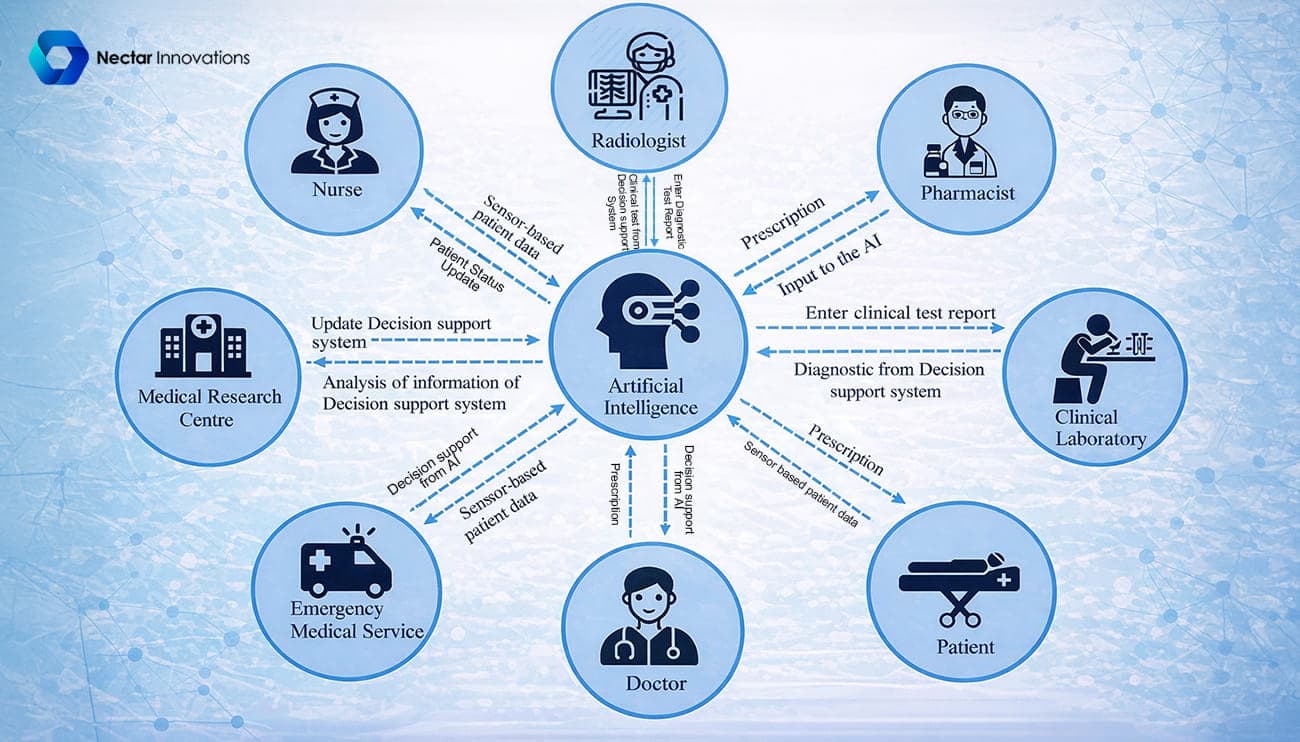
Three types of technology handle administrative work differently. Understanding which does what matters for your implementation decisions.
- The Difference Between Following Rules and Making Decisions
Most healthcare executives use "AI" and "automation" interchangeably. That's a mistake.
Automation follows predetermined steps. Send appointment reminders. Flag missing insurance information. Route calls based on keywords. It works well for repetitive tasks that rarely change.
AI makes decisions based on patterns it recognizes. It reads clinical notes and extracts relevant information for billing codes. It predicts which patients are likely to no-show and adjusts schedules accordingly. It handles complex conversations with patients about symptoms and care instructions.
What This Means for Your Operations
|
Task Type
|
Automation Handles
|
AI Handles
|
|
Decision-making
|
Follows fixed rules
|
Adapts based on context
|
|
Learning
|
Requires manual updates
|
Improves with more data
|
|
Complexity
|
Simple, repetitive work
|
Nuanced, variable processes
|
|
Examples
|
Appointment reminders
|
92% Clinical documentation analysis
|
Here's the practical difference: automation saves time on tasks you're already doing efficiently. AI changes how you approach tasks that currently require human judgment
- Reading and Understanding Clinical Text
Natural language processing—essentially AI that reads and comprehends medical notes—addresses one of healthcare's biggest bottlenecks. Instead of having staff manually review thousands of clinical notes to extract billing information or track patient conditions, these systems automatically identify and categorize relevant information.
The performance metrics are solid:
- 88% accuracy in detecting cognitive impairment from clinical notes
- 96% accuracy in correctly identifying patients who don't have specific conditions
- Overall reliability scores ranging from 67% to 98% depending on the specific use case
Advanced versions using transformer-based models achieve 99.7% accuracy in some applications. What this means: these systems can reliably extract billing codes, track patient outcomes, and flag concerning changes in patient status without human review.
- Predicting Patterns to Optimize Operations
Machine learning algorithms analyze your historical data to forecast operational needs. Rather than reactive scheduling based on yesterday's patterns, these systems predict demand, identify bottlenecks, and recommend resource allocation.
Four areas where this creates measurable impact:
Resource Planning - AI analyzes patient flow patterns to predict staffing needs and equipment requirements
Patient Routing - Algorithms direct patients to appropriate care settings, reducing unnecessary emergency department visits
Schedule Optimization - Systems forecast patient demand and recommend optimal staffing levels, particularly valuable for operating room scheduling
Supply Management - Machine learning tracks usage patterns to prevent both shortages and overstocking
Half of U.S. hospitals now use AI for scheduling, while 36% have implemented it for billing. Gartner research identifies ambient listening for documentation as a "likely win" for health systems—improving coding accuracy, speeding reimbursement, and reducing clinician documentation time.
These systems work together as an interconnected platform, providing real-time operational insights that help administrators shift from constantly reacting to problems to preventing them
Five AI Applications That Actually Work
Here's what separates healthcare organizations seeing real results from those still struggling with pilot programs: they focus on specific, measurable problems rather than broad "digital transformation."
The data from successful implementations reveals clear patterns. These aren't theoretical use cases or vendor promises—they're outcomes from organizations that moved beyond proof-of-concepts to production systems.
- AI Documentation That Physicians Actually Use
The Permanente Medical Group tested AI scribes across 2.5 million patient encounters. The results: physicians saved 15,791 hours of documentation time—equivalent to adding 1,794 workdays back to their schedules. More telling: 84% of physicians reported better patient communication, and 82% noted increased job satisfaction.
Patients noticed too. Forty-seven percent observed their doctors spent less time looking at computers during visits.
This works because it solves a real problem. Physicians hate documentation more than any other administrative task. Give them a system that captures clinical notes without disrupting patient interaction, and adoption follows.
- Patient Communication Systems That Reduce Call Volume
AI chatbots handle the routine questions that consume front desk time: appointment scheduling, medication reminders, basic health information. One healthcare system reported $2.4 million in first-year savings from reduced contact center calls and new patient revenue.
The numbers support broader adoption. Healthcare chatbot spending is projected to grow from $196 million in 2022 to $1.2 billion by 2032. Industry-wide savings could reach $3.6 billion by 2025.
The key is managing expectations. These systems excel at routine interactions but still require human oversight for complex cases.
- Scheduling That Predicts Demand
Predictive scheduling sounds complicated until you see the results. Queen's Medical Center implemented AI-driven scheduling and achieved:
- 77% reduction in schedule creation time
- 68% improvement in safe staffing frequency
- 100% adherence to required staffing rules
- 8% decrease in labor costs
These systems forecast patient demand 120 days ahead with 96-98% accuracy. For administrators struggling with staffing shortages, this represents actual relief rather than theoretical efficiency.
- Claims Processing That Prevents Denials
Rather than fixing denied claims, AI systems prevent them. These platforms analyze claims against payer policies before submission, flagging potential issues early. The financial impact: denial resolution costs drop from $40 per account to under $15.
This matters because 69% of practices report increased claim denials year-over-year. Fighting denials after submission costs more and delays payment. Prevention works better.
- Triage Systems That Reduce Errors
Johns Hopkins developed TriageGO, an AI tool that recommends appropriate triage levels within seconds. Machine learning algorithms for triage show 0.3-8.9% reductions in mis-triage rates.
Emergency departments operate under constant pressure. Any system that helps staff make faster, more accurate triage decisions provides immediate value.
These five applications work because they address specific operational pain points rather than promising broad transformation. They reduce workload by handling tasks humans find tedious or error-prone, freeing staff for higher-value work.
The ROI Numbers Everyone Wants to See
The hardest question I get from healthcare executives: "What's the actual return on this investment?" Here are the numbers that matter.
- What Real Clinics Are Saving
The facilities moving fastest aren't chasing theoretical savings. They're tracking measurable results:
AdventHealth cut hiring decision time by 40% and doubled their closed job requisitions in 90 days. One hospital system dropped nurse vacancy rates from 30% to zero in eight months. These aren't marginal improvements—they're operational breakthroughs.
Patient flow improvements show up immediately. Automated check-ins and faster test results delivery reduce wait times across the board. When scheduling systems can predict demand and optimize staffing, occupancy rates increase 10-15% while employee satisfaction improves.
- Where the Money Actually Goes
Healthcare spends 25% of its budget on administration. That's the target.
McKinsey's analysis shows AI can automate 45% of administrative tasks, generating $150 billion in annual savings. Private payers could save $80-110 billion over five years. Physician groups might cut costs by 3-8%—that's $20-60 billion.
But here's what those numbers don't show: the indirect savings from reduced turnover, less burnout, and staff who actually want to stay.
- Time Savings That Actually Matter
|
Task
|
Time Recovered
|
What It Means
|
|
Documentation
|
15,791 hours annually
|
1,794 workdays back to patient care
|
|
Clinical diagnosis
|
3.33 hours per day per hospital
|
$1,666 daily savings per facility
|
|
Treatment planning
|
21.67 hours per day per hospital
|
$21,667 daily savings per facility
|
|
Overall clinical time
|
12 minutes per visit
|
Burnout drops from 52% to 39%
|
The 12 minutes per visit matters most. When physicians get two hours back each day, they stop taking work home. That's when you see burnout rates actually drop, not just efficiency metrics improve.
The question isn't whether these systems pay for themselves. It's how quickly you can implement them before your competition does.
Getting Your Organization Ready (Without the Usual IT Headaches)
Most healthcare IT projects fail because organizations rush into technology before understanding what they're solving for. Here's a simpler approach.
- Start With What Actually Breaks
Skip the infrastructure audit spreadsheets. Instead, follow one patient journey from check-in to checkout and write down every place staff touches the same information twice. That's your automation opportunity map.
I've seen organizations spend months evaluating EHR compatibility when their real bottleneck was front desk staff manually entering insurance information that already existed in three different systems. The technical requirements become obvious once you identify the actual workflow problems.
Your current systems matter less than you think. Most healthcare organizations already have the processing power and data storage needed for basic AI applications. The question isn't whether your infrastructure can handle AI—it's whether your team knows which processes to automate first.
- Three Decisions That Determine Success
Decision 1: Data or Workflows First?
Many organizations start with data integration projects that take months. The faster approach: pick one workflow that frustrates staff daily and automate that. Documentation, scheduling, or billing—choose one. Data standardization happens as you go, not before you start.
Decision 2: Buy Complete Solutions or Build Integrations?
Healthcare-specific AI vendors understand compliance requirements and integrate with existing EHR systems. Generic AI tools require more internal IT work but cost less upfront. Your choice depends on whether you have dedicated IT resources or need plug-and-play solutions.
Decision 3: Pilot or Full Implementation?
Start with one department using one AI tool for 30 days. Track time saved per staff member, error rates, and user satisfaction. This gives you real numbers before expanding.
- The Questions That Matter More Than Technical Specs
When evaluating vendors, ask these instead of the usual feature comparisons:
- How long until our staff sees measurable time savings?
- What happens when your system is down for maintenance?
- Who handles training, and how long does adoption typically take?
- Can we export our data if we switch vendors later?
Form your evaluation team with the people who will actually use these systems daily—front desk staff, billing coordinators, physicians—not just IT and procurement. Their questions reveal implementation challenges that technical demos miss.
The goal isn't perfect preparation. It's identifying which administrative burden to eliminate first, then moving fast enough that staff see improvement before they get skeptical about another "IT initiative."
The conventional wisdom about healthcare AI says you need a comprehensive digital transformation strategy before you can see results.
That's backwards.
The organizations actually reducing administrative burden aren't waiting for perfect systems or complete staff buy-in. They're starting with one broken process—usually documentation or scheduling—and fixing it. The 77% reduction in scheduling time at Queen's Medical Center didn't happen because they had the best infrastructure. It happened because they picked the right problem to solve first.
Here's what I'm seeing across successful implementations: the facilities that move fast treat AI like a business decision, not a technology project. They measure time saved per physician, not system capabilities. They track burnout reduction, not feature adoption.
The healthcare staffing crisis won't wait for you to get comfortable with AI terminology. When you're already short 3 million workers and losing more every month, the question isn't whether these systems are perfect. It's whether they're better than the manual processes breaking your staff.
Most executives tell me they're worried about moving too quickly with AI. But I haven't met one who regrets getting their physicians back 12 minutes per patient visit.
What would change if you assumed your competitors were already implementing these solutions?
Key Takeaways
Healthcare AI solutions are delivering measurable results in reducing administrative burden and improving operational efficiency across real clinical settings.
- AI scribes save 40% of documentation time - Real clinics report saving 15,791 hours annually, equivalent to 1,794 workdays of physician time
- Automated scheduling cuts workload by 77% - Predictive AI systems reduce schedule creation time while improving staffing accuracy by 96-98%
- Billing automation reduces denial costs by 62% - AI-powered claims processing drops resolution costs from $40 to under $15 per account
- Staff burnout decreases significantly - Healthcare facilities using AI report burnout rates dropping from 51.9% to 38.8% among physicians
- ROI reaches $150 billion annually - McKinsey analysis shows AI can automate 45% of administrative tasks, generating massive healthcare savings
The evidence is clear: AI isn't just theoretical potential—it's a practical solution already transforming healthcare administration. Organizations that assess their readiness, map workflows for automation opportunities, and choose the right AI partners position themselves to reclaim valuable time for patient care while dramatically reducing operational costs.



 by
by